

Fishing in Kemijoki River Has a Thousand-Year History, Woven with Seers, Legends, Beliefs and Myths
Come, pike, gliding near,
Water-dog, drawing here,
Come and take the lure,
Let the hook be sure,
Row, oh row, my rower true,
That I might land a mighty pike!
The entrails go to the rower,
The head to the one who steers,
The tail-flesh to the one who caught it,
The middle to the one who cooks,
The liver to the one who carries it home.
Water-dog, drawing here,
Come and take the lure,
Let the hook be sure,
Row, oh row, my rower true,
That I might land a mighty pike!
The entrails go to the rower,
The head to the one who steers,
The tail-flesh to the one who caught it,
The middle to the one who cooks,
The liver to the one who carries it home.
When an old Sámi fisherman prepared to set out into the wilderness of Upper Lapland, he never picked up his net, lifted his landing scoop, or took the oars in hand before first speaking with the unseen powers above him.
This was not superstition in the way the modern mind understands the word. It was a higher agreement — a negotiation with a greater presence.
Maintaining the balance of the world was never the exclusive right of gods. It belonged to every person. The fisherman and the hunter asked permission to take something for themselves from what belonged to all.
This spiritual bond with nature is not a folkloric curiosity — it is a living inheritance
This connection to the hunt is not some minor folkloristic footnote. It is part of a universal human awareness stretching from the shores of the Gulf of Finland to the Siberian tundra, the prairies of North America, and the rainforests of the Amazon — a worldview in which one never enters nature, or hunts within it, without first asking its permission.
This was not superstition in the way the modern mind understands the word. It was a higher agreement — a negotiation with a greater presence.
Maintaining the balance of the world was never the exclusive right of gods. It belonged to every person. The fisherman and the hunter asked permission to take something for themselves from what belonged to all.
This spiritual bond with nature is not a folkloric curiosity — it is a living inheritance
This connection to the hunt is not some minor folkloristic footnote. It is part of a universal human awareness stretching from the shores of the Gulf of Finland to the Siberian tundra, the prairies of North America, and the rainforests of the Amazon — a worldview in which one never enters nature, or hunts within it, without first asking its permission.
A world where everything is alive, and everything is connected
The roots of modern ecological thinking reach deep into the stories, myths, and legends that arose long before the scientific worldview that dominates today — before the Enlightenment, before Darwin, Galileo, Newton, and Descartes, before the very foundations of natural science existed. For most of human history, people lived inside a worldview where the line between the living and the non-living, between spirit and matter, was either entirely foreign or simply irrelevant.
Stones were alive. Rivers remembered. Forests listened. Stars spoke.
This worldview, preserved in Finnish mythology, has been studied by scholars such as Elias Lönnrot, Anna-Leena Siikala, Martti Haavio, Lauri Honko, Matti Kuusi, Juha Pentikäinen, Vesa-Pekka Herva, and Antti Lahelma — alongside international voices such as Hungarian folklorist Mihály Hoppál. Thanks to their work, we know a great deal today about the ancient myths and everyday folk beliefs surrounding fishing and hunting.
Lönnrot's own Kalevala is, in this sense, more than a national epic — it is also an archaeological and anthropological record of an older spirit-world and its daily customs. In the Kalevala , hunting and fishing always take place at the border between two realities. Aino drowns and becomes a spirit of the water — the hunted and the hunter dissolve into one another. Väinämöinen does not simply catch fish; he holds a dialogue with the water itself. When he lands a pike, it is a meeting of spirits, not merely an act of extracting a resource from the wild.
Lönnrot himself wrote in his field notes from the 1830s:
"In the understanding of the people, nothing happens in the forest or the water without the consent of its guardian spirit. A hunter who forgot to ask returned empty-handed — or did not return at all."
This was not fear. It was everyday wisdom — and it is the same quiet wisdom that still governs how a guide reads a river in Finnish Lapland today.
Lönnrot's own Kalevala is, in this sense, more than a national epic — it is also an archaeological and anthropological record of an older spirit-world and its daily customs. In the Kalevala , hunting and fishing always take place at the border between two realities. Aino drowns and becomes a spirit of the water — the hunted and the hunter dissolve into one another. Väinämöinen does not simply catch fish; he holds a dialogue with the water itself. When he lands a pike, it is a meeting of spirits, not merely an act of extracting a resource from the wild.
Lönnrot himself wrote in his field notes from the 1830s:
"In the understanding of the people, nothing happens in the forest or the water without the consent of its guardian spirit. A hunter who forgot to ask returned empty-handed — or did not return at all."
This was not fear. It was everyday wisdom — and it is the same quiet wisdom that still governs how a guide reads a river in Finnish Lapland today.
An ancient "fishing license," sought from the guardians of forest and water
Little perch, so small and slender,
Also pike of scattered teeth,
Come now to the hook and take it,
Bend the barbed and cruel iron,
Curve yourself around its curling!
Take it with your greater mouth,
With your wider, broader jawbones,
With your scattered, sparse-set teeth.
Also pike of scattered teeth,
Come now to the hook and take it,
Bend the barbed and cruel iron,
Curve yourself around its curling!
Take it with your greater mouth,
With your wider, broader jawbones,
With your scattered, sparse-set teeth.
In many cultures, the pact made with nature traces back to a creation myth — the moment humankind was first granted permission to exist and to draw sustenance from the earth.
In Finnish mythology, Tapio, lord and king of the forest, rules over all its creatures. Tapio does not hand his catch to whoever simply takes — he gives it to whoever comes rightly, at the right time, with the right heart.
An entire worldview is compressed into these few lines. The forest is a storehouse — the pantry of life itself. Its master decides to whom it is opened. A person does not come to plunder, but to ask. And asking always carries with it the recognition of a limit: I will not take more than my share.
In Finnish mythology, Tapio, lord and king of the forest, rules over all its creatures. Tapio does not hand his catch to whoever simply takes — he gives it to whoever comes rightly, at the right time, with the right heart.
An entire worldview is compressed into these few lines. The forest is a storehouse — the pantry of life itself. Its master decides to whom it is opened. A person does not come to plunder, but to ask. And asking always carries with it the recognition of a limit: I will not take more than my share.
The Kalevala preserves a prayer once spoken before the hunt:
"Tapio, king of the forest, / Mielikki, gracious mistress — / open your wide storehouses, / release your animals from their pen. / I do not ask for more than enough, / I ask only for what I need."
"Tapio, king of the forest, / Mielikki, gracious mistress — / open your wide storehouses, / release your animals from their pen. / I do not ask for more than enough, / I ask only for what I need."
In the shamanic traditions of Siberia, the same cosmic pact appears even more explicitly. In Nenets belief, the spirit of the land, Ya Nebya, owns every animal. The hunter does not kill a reindeer — he releases a soul that Ya Nebya has, for a time, worn in the reindeer's form. In return, the hunter or fisherman must perform a rite that returns the soul of the catch to the great cycle.
Anthropologist Roberte Hamayon has documented this exchange precisely: it describes shamanic hunting as not an assault on nature, but a trade between human life and the greater world of being — a pact whose terms cannot be broken without consequence.
Anthropologist Roberte Hamayon has documented this exchange precisely: it describes shamanic hunting as not an assault on nature, but a trade between human life and the greater world of being — a pact whose terms cannot be broken without consequence.
The sacred connection of fishing
In fishing, this idea of permission takes an especially tangible form, because water itself is a symbol of the border — the surface between the living and the dead, the seen and the unseen.
In Finnish folk tradition, casting a net was a ritual with its own careful protocol. The net could not touch the ground before entering the water — to do so would insult the water's guardian spirit. The first catch was sometimes returned — not as waste, but as a gift, a sign that the one fishing acknowledged the pact still stood.
Ethnologist Uno Harva, whose research into the religions of the Finno-Ugric peoples remains foundational, recorded fishing rites from the shores of Lake Onega in the early 1900s, where the one casting the net would quietly speak:
In Finnish folk tradition, casting a net was a ritual with its own careful protocol. The net could not touch the ground before entering the water — to do so would insult the water's guardian spirit. The first catch was sometimes returned — not as waste, but as a gift, a sign that the one fishing acknowledged the pact still stood.
Ethnologist Uno Harva, whose research into the religions of the Finno-Ugric peoples remains foundational, recorded fishing rites from the shores of Lake Onega in the early 1900s, where the one casting the net would quietly speak:
"Lord of the bay, mistress of the bay — I come without ill will. I take what you give. I do not take what you keep."
Here, permission unfolds in three layers: permission to enter, permission to take what is given — and, most significant of all, the acknowledgment that some things simply must not be taken. This last dimension is what separates traditional fishing from modern resource management: the limit does not come from outside, from law or regulation. It rises from within the world itself, from a higher pact and an older way of seeing.
Jänkäkoira honors both of these authorities — what belongs to the Crown by the Crown's own law, and what the land itself grants, on its own terms, to those who ask rightly.
Jänkäkoira honors both of these authorities — what belongs to the Crown by the Crown's own law, and what the land itself grants, on its own terms, to those who ask rightly.
Lady of the lake, fine-skirted,
Ahti of the river, gracious —
Give to me your perch in plenty,
Send the ruffe up from the shallows,
Stir the roach to rise and gather,
Wake the vendace from their stillness,
And the deep-lake perch beside them!
Bring them out from Tompsa's waters,
Draw them out from Vempsa's currents,
Out from Kiikkala, Koikkala!
Ahti of the river, gracious —
Give to me your perch in plenty,
Send the ruffe up from the shallows,
Stir the roach to rise and gather,
Wake the vendace from their stillness,
And the deep-lake perch beside them!
Bring them out from Tompsa's waters,
Draw them out from Vempsa's currents,
Out from Kiikkala, Koikkala!
An invitation into a world most travelers never find
This is the country Jänkäkoira fishes — not a backdrop, but a living presence with its own memory and its own terms. For the discerning traveler who has already sat with silence, who knows what it means to be fully present on a mountain trail or in a meditation hall, Finnish Lapland offers something few destinations on earth still can: a landscape where mindfulness was never a practice to be learned, but the oldest possible way of being outdoors.
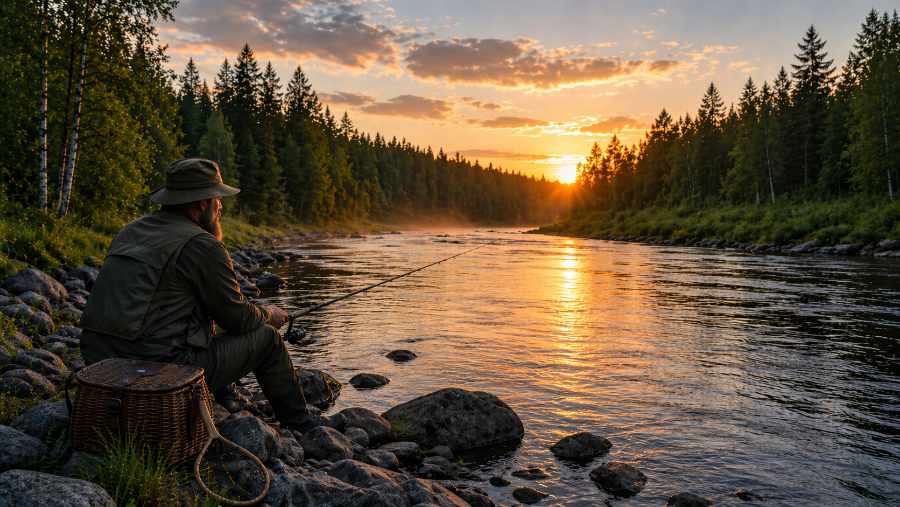
Guide Juhani "Junnu" Korpela leads a select number of travelers each season into this world from Vuostimo, onto the private waters of Kemijoki, Kairijoki, Naruskajoki, and Värriöjoki — rivers still spoken of, in the old way, as places one enters by asking rather than taking. Under the midnight sun or across the hush of the Arctic wild, a day with Jänkäkoira is far removed from an ordinary guided excursion. It is an old, unhurried negotiation between a person and a river that remembers — led by someone raised from childhood to read both the water and what moves, unseen, beneath it.
Guide Juhani "Junnu" Korpela leads a select number of travelers each season into this world from Vuostimo, onto the private waters of Kemijoki, Kairijoki, Naruskajoki, and Värriöjoki — rivers still spoken of, in the old way, as places one enters by asking rather than taking. Under the midnight sun or across the hush of the Arctic wild, a day with Jänkäkoira is far removed from an ordinary guided excursion. It is an old, unhurried negotiation between a person and a river that remembers — led by someone raised from childhood to read both the water and what moves, unseen, beneath it.
For those who have moved beyond conventional luxury travel in search of something rarer still — the kind of depth that mindfulness and contemplative practice first opened them to — Jänkäkoira offers private passage into a wilderness where the old pact still holds.