

The Kemijoki and its tributaries — Finland's largest fly-fishing water
THE BEST OF FLY FISHING
” Salla's rapids are a paradise for grayling”
The scale of the Kemijoki watershed is difficult to grasp. Counting its tributaries — any moving channel at least two metres wide — it covers nearly 26,000 kilometres of river. No other watershed in Finland holds that much moving water. This is a place where a fly fisher could spend an entire life and never wade the same rapid twice. And yet most people drive straight past it on the highway, headed somewhere else. Their loss is your opportunity.
Finland's finest fly water is here
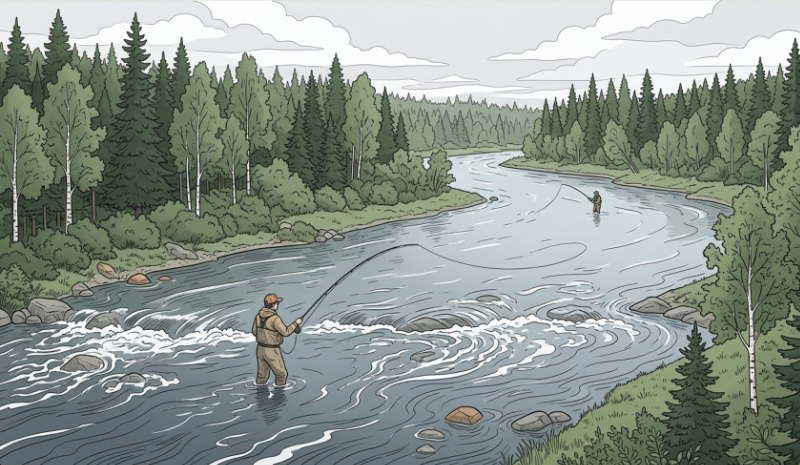
The main channel — a wilderness current that gives nothing away easily
On the Ounasjoki and the upper Kemijoki, the primary target species are pike, grayling, and trout. The main channel is no easy target — it's wide, fast, and demands both the ability to read water and patience from the angler. But it rewards those who bring both. Along the roughly 40-kilometre stretch between the Kitinen and Savukoski lie the Kemijoki's largest rapids, the river widening between 50 and 100 metres; both the large and small rapids serve as feeding grounds for trout and grayling — outstanding territory for both fly and lure fishing. The Kemijoki's headwaters can surprise: they can produce trout, sometimes remarkably well, and grayling come readily, the largest exceeding 40 centimetres.
The Ounasjoki — Lapland's crown jewel
The Ounasjoki was protected under special legislation in 1983, and its ecological condition is excellent. By Finnish standards it's rare: a large, unique, undammed Lappish river. The Ounasjoki holds several fine rapid stretches — Aapiskoski, Ankkurinkoski, Marraskoski — and every one of its tributaries and streams carries grayling and trout. An experienced angler knows the best water lies upstream. Around Lohiniva begins the stretch of the Ounasjoki the old stories are told about. This river doesn't promise easy catches — it promises real ones.
From the upper Kemijoki to Savukoski — an undammed river stretch
The upper Kemijoki is an undammed river, its natural state altered mainly by historical timber-floating channel clearance and forest drainage. Once floating ended, the rapids were restored. Several tributaries flow into the upper Kemijoki, the most significant being the Kairijoki, the Värriöjoki, and the Tenniöjoki. This is the Kemijoki as it looked before the age of dams — wide, brown, enigmatic.
The Kairijoki — the kingdom of grayling in Eastern Lapland
The Kairijoki is a river anglers whisper about to one another. More than half its main channel runs as freely flowing rapids, superbly suited to fly fishing, and the whole river is wadeable. Naturally reproducing trout and Arctic char populations live in its small tributaries. Here grayling isn't a bycatch — it's the king the river is fished for.
The Värriöjoki and Tenniöjoki — secret tributaries

The Värriöjoki in Savukoski and the Tenniöjoki in Salla are names you won't find in fly-fishing guidebooks — and that's exactly why they're worth knowing. Both rivers flow into the upper Kemijoki undammed and almost untouched. Their water is exceptionally clear, and grayling love them for it. The Värriöjoki skirts the edge of the Värriö Strict Nature Reserve, where foot traffic is scarce and fishing pressure minimal — its water has stayed in a natural state for decades.
The Tenniöjoki, by contrast, is wider and flows more gently. Its slow stretches and deep pools reward whoever has the patience to wait. On both rivers, grayling only rises to the surface in the evening, once most other travellers have already gone home. These aren't rivers you stumble onto by accident — you have to seek them out on purpose.
The Tenniöjoki, by contrast, is wider and flows more gently. Its slow stretches and deep pools reward whoever has the patience to wait. On both rivers, grayling only rises to the surface in the evening, once most other travellers have already gone home. These aren't rivers you stumble onto by accident — you have to seek them out on purpose.
Why clear water decides everything
On the Kemijoki watershed, the best fly water reveals itself at a glance. Pull over at almost any roadside spot, and you can usually judge from the colour of the water alone whether it's worth fishing — before you've even unpacked your gear. If the river running beside the road is black with bog-stain, don't bother trying. But if the water runs clear and clean, then with a little luck you can take home a very fine catch of grayling. Grayling is the most sensitive indicator of a watershed's health there is. It's the first to vanish, and the last to return.
The Kemijoki watershed — a lifetime's project
The Kemijoki watershed isn't a destination you visit once. It's a place you return to — a little wiser each time, always finding something new. Even the seasoned angler who has roamed the whole Cap of the North and taken magnificent fish in magnificent places still finds challenge and fine fly-fishing on the Kemijoki. A lifetime isn't enough to exhaust what these waters hold — and a guide who truly knows them shortens your learning curve dramatically.